
UAE Minimum Wage & Equal Pay Compliance 2025: What HR Teams Need to Know


When HR teams in the UAE search for “minimum wage 2025”, they’re often looking for a simple number. But here’s the truth: there isn’t one. Unlike other regions that publish a specific hourly or monthly rate, the UAE focuses on ensuring fair, timely, and contractually defined pay, not a fixed minimum threshold.
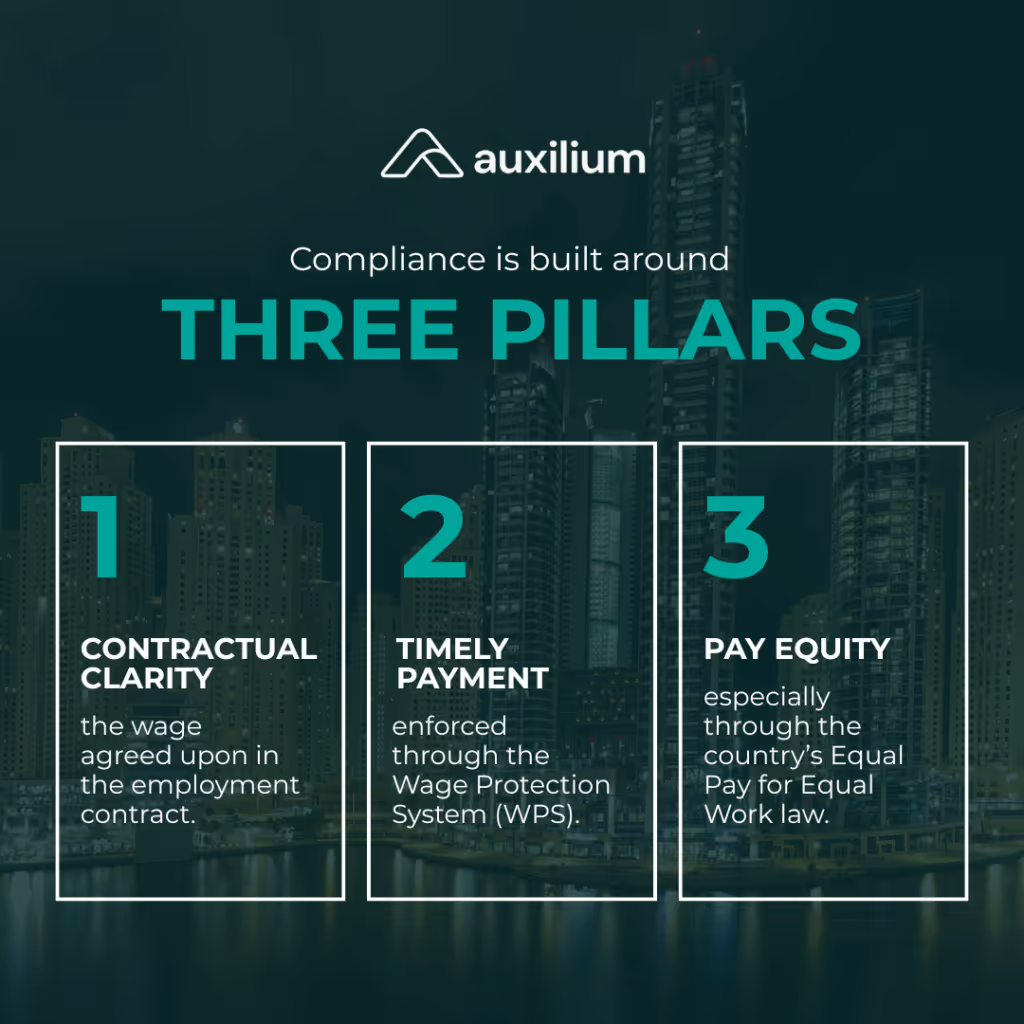
Instead of a figure, compliance is built around three pillars:
- Contractual clarity, the wage agreed upon in the employment contract.
- Timely payment, enforced through the Wage Protection System (WPS).
- Pay equity, especially through the country’s Equal Pay for Equal Work law.
For HR professionals, this means “minimum wage” isn’t about finding the lowest legal amount, it’s about creating and maintaining a transparent, equitable, and compliant pay system.
Why the UAE Took a Different Approach
The UAE’s labour framework, under Federal Decree-Law No. 33 of 2021 and its Executive Regulations, focuses on practical protection. Employers are legally required to pay workers on time, in full, and through official channels. This is where the Wage Protection System (WPS) comes in.
Launched by the Ministry of Human Resources and Emiratisation (MOHRE) and the UAE Central Bank, WPS electronically tracks salary transfers, ensuring that every employee receives the exact amount agreed upon in their contract. If payments are delayed, short, or missing, the system flags it, triggering legal or administrative action.
This shift from “minimum amount” to “minimum standard” is intentional. It places responsibility squarely on employers to honour contracts, avoid pay delays, and treat wage compliance as part of their governance culture, not a monthly chore.
Equal Pay for Equal Work: A Legal (and Ethical) Imperative
Since September 2020, the UAE has made it clear: men and women must receive equal pay for the same work, or work of equal value. This isn’t a slogan; it’s codified in law and reinforced by official government guidance.
But “equal value” is broader than identical roles. It’s about assessing jobs based on skill, effort, responsibility, and working conditions. Two employees may have different titles but, if their roles deliver similar value to the organisation, they should be compensated equally, unless objective, job-related factors (such as experience or performance) justify a difference.
For HR leaders, this means investing in transparent salary banding, gender pay audits, and job evaluation frameworks. It also means documenting every pay decision. If challenged, the employer must prove that any pay gap is based on merit, not bias.
Practical Tip: Conduct annual gender pay analyses. Even small variances can become big liabilities if not backed by clear rationale.
The Wage Protection System (WPS): The Heart of Payroll Compliance
Think of the Wage Protection System as the UAE’s compliance heartbeat. Every private-sector salary must move through it, allowing authorities to track payments and ensure that workers are protected.
Under this system, wages are transferred electronically via banks and exchange houses approved by the Central Bank of the UAE. Employers must pay salaries within the contractually agreed period, usually monthly, and in full.
When an employer misses or delays payment, WPS automatically alerts regulators, and the company risks fines, licence restrictions, or limitations on new work permits. In some cases, repeated non-compliance can trigger audits or suspension of government services.
The best defence? Consistency. A payroll process that reconciles contract data, ensures WPS submissions are error-free, and monitors rejection logs will protect your business from unnecessary exposure.
Free Zone Considerations: DIFC and ADGM Play by Their Own Rules
While mainland companies follow MOHRE’s Labour Law, entities operating in free zones, notably the Dubai International Financial Centre (DIFC) and the Abu Dhabi Global Market (ADGM), follow separate employment regimes.
The DIFC Employment Law (consolidated July 2025) and ADGM Employment Regulations both share one key theme: strong non-discrimination and equal pay principles, but no statutory minimum wage. Employers must provide written contracts, detailed pay statements, and equal treatment across genders, but salary levels remain market-driven.
What differentiates free zones is the level of documentation and enforcement. DIFC, for example, allows employees to claim compensation for proven discrimination, while ADGM’s updated guidance in 2024 stresses “minimum entitlements” and transparent wage protection.
For HR professionals managing multi-zone entities, this means understanding which regime applies, and adjusting contracts, payroll systems, and HR policies accordingly.
TopicMainland (MOHRE)DIFCADGMMinimum wageNo federal figure; contracted wage must be paid via WPSNo statutory figure; itemised pay & non-discriminationNo statutory figure; minimum entitlements & wage protectionEqual payEqual work / equal value in private sectorNon-discrimination & remedies; apply equal-pay principlesNon-discrimination and wage-protection guidancePayroll channelWPS mandatoryDIFC entities follow DIFC law; wage payment standards apply; (WPS typically not the mechanism inside DIFC)ADGM regime; wage-protection standards applyKey riskWPS timing/amount mismatchesNon-discrimination claims and documentation gapsDocumentation gaps on entitlements
Designing a Fair and Compliant Pay Framework
Without a fixed national minimum wage, companies must rely on structured internal frameworks to ensure fair compensation. A strong pay system typically includes:

- Market benchmarking: Understand salary trends for each role level across your industry.
- Transparent job grading: Categorise roles by complexity, responsibility, and contribution.
- Clear contracts: Ensure all salary details, payment frequency, and benefits are spelled out in writing.
- Payroll integrity: Align approved payroll with WPS submissions and maintain digital records.
- Gender pay audits: Conduct regular reviews to identify and correct unjustified discrepancies.
By embedding these principles into HR operations, companies not only stay compliant, they also build trust and credibility with their employees, regulators, and investors.
Penalties and Compliance Risks
The UAE government takes wage violations seriously. Under the Executive Regulations, MOHRE has authority to impose administrative measures against employers who fail to pay on time. These can include fines, restrictions on new work permits, or temporary suspension of company activities.
Beyond legal consequences, there’s also the reputational risk. In an increasingly transparent market, payroll compliance is viewed as a reflection of corporate integrity. Investors, clients, and future employees are watching.
Likewise, breaches of the equal pay provisions—particularly in free zones like DIFC—can lead to legal claims, back pay awards, and penalties. The cost of non-compliance is far greater than the cost of building a compliant, fair system from the start.
By 2025, UAE employers need to think about “minimum wage” not as a single number, but as a minimum standard of compliance. That means:
- Paying employees exactly what’s agreed, on time, via WPS.
- Ensuring gender parity for the same or equal-value work.
- Adapting to free-zone differences, especially in DIFC and ADGM.
- Maintaining documentation that can withstand inspection or dispute.
When these pieces work together, organisations create a pay culture built on fairness, transparency, and accountability—all pillars of long-term success in the UAE market.
Your Next Step
Handling the complexities of payroll and employment law in the UAE can feel overwhelming, especially when managing multiple entities or free-zone operations.
That’s where a local partner helps. Auxilium’s Employer of Record (EOR) services are designed to manage payroll, visa processing, and end-of-service obligations across the GCC, including the UAE. We handle compliance so your team can focus on growth, not red tape.
Book a confidential consultation to review your current UAE pay compliance framework and discover how to simplify employment operations across the Gulf.
Frequently Asked Questions
What explains the absence of a universal minimum wage in the United Arab Emirates is that the federal labour law does not prescribe a fixed wage floor; instead it mandates that wages must be sufficient to meet an employee’s basic needs and allows wages to be negotiated based on role, skills and sector.
What the lowest salary in Dubai can be is not legally defined, since there’s no fixed minimum wage; however, market-guidelines suggest entry-level salaries for unskilled workers in the range of AED 1,100–1,800 per month, and for skilled labour roughly AED 5,000 per month, depending on role, allowances and employer.
How much the UAE pays per hour depends entirely on the contract and role because there is no statutory hourly minimum wage; employers must ensure salaries meet basic needs, and hourly rates must be derived from the agreed monthly wage divided by working hours (for example, a salary of AED 5,000 for 48 hours/week implies roughly AED 30-35/hour), but there is no official rate.



Schedule a Free Consultation
Tell us what you’re looking for and we’ll handle the rest.
Let's talk!
Please provide your details, and one of our specialists will promptly reach out to you.