
E-Learning Platforms Compared: Your 2025 Guide to LMS Software in the UAE

In 2025, choosing the right LMS software in the UAE is about much more than delivering online training. For HR leaders, it’s about meeting Emiratisation goals, maintaining compliance under the UAE Personal Data Protection Law (PDPL), and ensuring every employee, whether local or expat, has access to the right skills and learning pathways.
This guide walks you through how to compare learning management systems, what new technologies are shaping the field, and which features truly matter for UAE employers. I’ll also share real client lessons from across the Gulf to help you make a decision that’s not just smart, but strategic.
Why LMS Choices in the UAE Matter
Over the past two years, the UAE has seen a quiet but powerful transformation in how organisations approach learning. What used to be an optional “nice-to-have” platform for e-learning is now a core compliance tool for HR.
The reason? Emiratisation and PDPL. Employers with over 50 staff must now prove they’re developing Emirati talent, and at the same time, they’re legally responsible for protecting employee data. Your learning management system sits right in the middle of both challenges, it holds personal information, training records, and performance data that regulators can request during audits.
Unlike global markets, the UAE’s ecosystem is shaped by regional realities. Internal corporate learning systems generally don’t need KHDA or ACTVET permits, but if your company offers training as a service, those licenses become mandatory. And with the rapid expansion of UAE data centres, organisations are now expected to keep employee data onshore whenever possible. In short: compliance and capability are now intertwined.
The Technology Shaping Learning in 2025
The learning tech landscape has matured. Today’s learning management systems do far more than track completions, they can map skill gaps, personalise career paths, and integrate with HR and payroll systems.
In 2025, the most important shift has been from the old SCORM standard to the more modern xAPI and LTI. These allow HR teams to measure real outcomes, like linking safety training to reduced incident rates or tracking how leadership courses affect retention. The focus is on insight, not just information.
And as AI becomes more embedded in learning tools, expect platforms that automatically recommend training modules based on performance, create quizzes on the fly, and even summarise learning reports for managers. But don’t get lost in the tech buzz, make sure every new feature aligns with your compliance needs and company culture.
What to Look for in LMS Software (UAE Edition)
When evaluating platforms, it’s easy to be dazzled by dashboards and demo videos. But in the UAE, your shortlist should start with three questions:

Is it compliant? Is it culturally aligned? And can it scale across the GCC?
- Data Protection & Hosting: Ensure your LMS follows PDPL guidelines, especially around data storage and cross-border transfers. Ask your vendor exactly where your data is hosted, how it’s backed up, and who can access it. With local data centres now more available, many UAE companies prefer to host data within the country to reduce risk.
- Arabic-First Experience: A platform that doesn’t work well in Arabic will struggle to engage employees. The interface, reports, and even in-course fonts should support Arabic seamlessly. Learning only works if everyone feels included.
- Compliance Reporting: For Emiratisation, you’ll need dashboards that show how many UAE nationals have completed required courses, what skills are being developed, and where gaps remain. A system that allows you to export evidence for MoHRE audits saves weeks of admin time.
- Integration & Analytics: Look for xAPI and LTI compatibility, so your LMS can communicate with HR systems like Oracle, SAP, or Workday. This connectivity ensures your learning data feeds into performance reviews, payroll, and visa renewal records—a holistic HR ecosystem.
- Support & Adoption: Ensure your vendor offers local support during GCC business hours and understands regional nuances, from Friday-Saturday weekends to Ramadan schedules.
How to Compare LMS Platforms Effectively
Most HR teams in the UAE make the mistake of rushing into demos. But a thoughtful, structured approach can save both money and headaches.
Start by defining your deployment model. Are you only training internal employees, or will you also deliver courses externally (which may involve KHDA/ACTVET permits)? Then, clarify your non-negotiables: compliance with PDPL, availability of Arabic UX, and integration with your existing HR systems.
When you reach the demo stage, simulate a real scenario. Assign a compliance course to a “skilled role,” generate a mock Emiratisation report, and test how easily data exports into Excel or Power BI. These small tests reveal whether a platform fits your reality or just looks good on paper.
Finally, run a pilot for 30–45 days. Choose a department with strict compliance needs, like engineering or operations, and measure completion rates and manager feedback. The insights from this pilot will guide your rollout and your negotiation with the vendor.
The UAE’s Learning Landscape: Who’s Leading the Market
The region’s LMS market is expanding quickly, but a few patterns are clear:
- Enterprise Suites (like SAP SuccessFactors, Docebo, Cornerstone) offer powerful analytics and integrations, though Arabic language depth can vary.
- Open-Source Platforms (like Moodle or Totara) give flexibility and control, especially when hosted locally in the UAE, but they require more IT oversight.
- New Regional Players are emerging with Arabic-first designs and mobile-friendly interfaces. These are worth exploring if your workforce is largely on-site or field-based.
What matters isn’t the brand, it’s the fit. The right LMS aligns with your HR strategy, integrates smoothly, and respects your employees’ privacy and language.
Navigating Policy and Compliance
UAE employers must navigate three layers of regulation when deploying an LMS:
- Data Protection (PDPL): Your LMS holds personal data, so understand how your vendor manages transfers, encryption, and deletion requests.
- Emiratisation Reporting: The system should track skill development for Emirati employees and generate reports that align with MoHRE formats.
- Training Partnerships: If you buy courses or content from external providers, confirm that those vendors hold the necessary KHDA or ACTVET licenses—your reputation is tied to theirs.
Together, these three elements define whether your LMS will stand up to scrutiny.
From Implementation to Impact: A 90-Day Roadmap
Once you’ve selected a platform, think beyond the go-live date. Implementation success depends on planning, communication, and measurement.
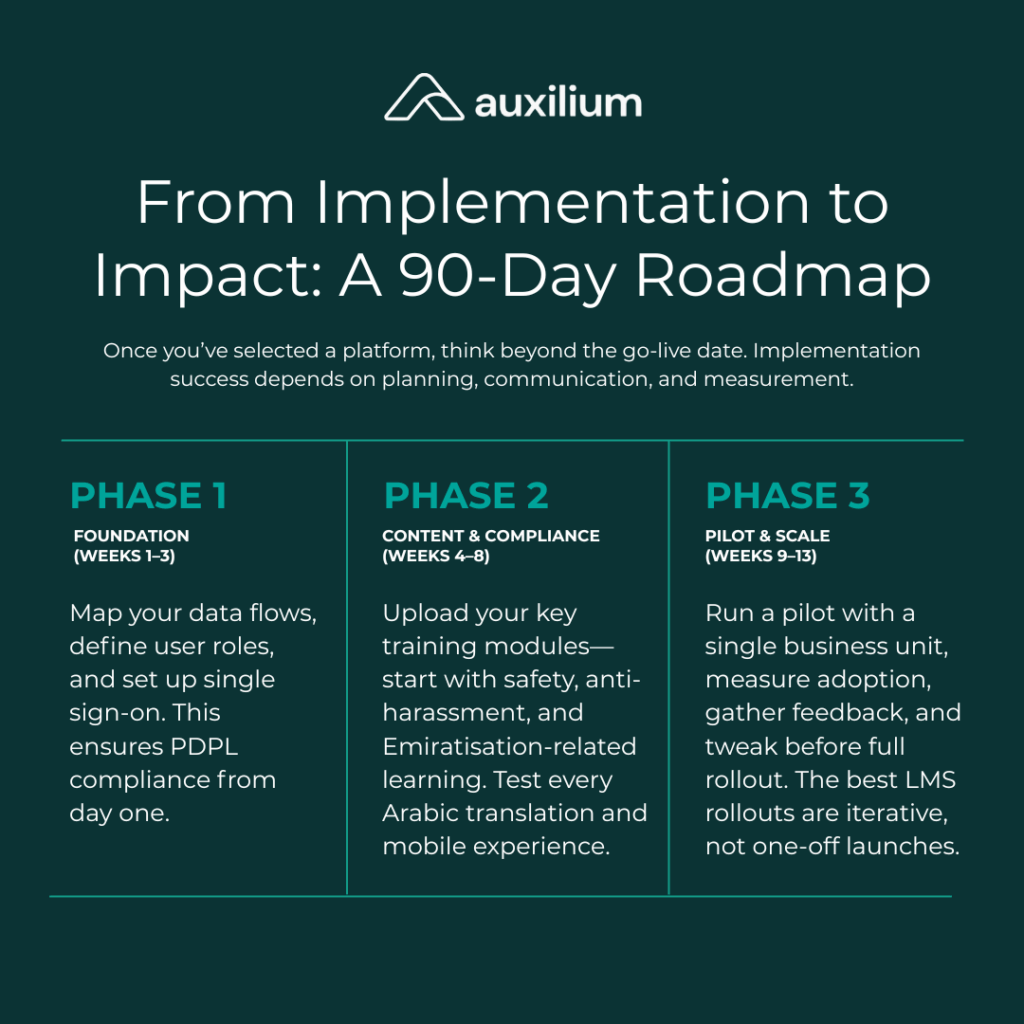
Phase 1: Foundation (Weeks 1–3)
Map your data flows, define user roles, and set up single sign-on. This ensures PDPL compliance from day one.
Phase 2: Content & Compliance (Weeks 4–8)
Upload your key training modules—start with safety, anti-harassment, and Emiratisation-related learning. Test every Arabic translation and mobile experience.
Phase 3: Pilot & Scale (Weeks 9–13)
Run a pilot with a single business unit, measure adoption, gather feedback, and tweak before full rollout. The best LMS rollouts are iterative, not one-off launches.
Balancing Off-the-Shelf and Open-Source LMS Options
There’s no one-size-fits-all answer. Off-the-shelf suites are great for organisations that want instant functionality, strong analytics, and dedicated support, but they can limit flexibility around data hosting.
Open-source systems, meanwhile, give full control and local hosting freedom, but they require technical expertise and reliable implementation partners. The right choice depends on your internal resources and compliance risk tolerance.
Final Thoughts: The Future of Learning is Compliance-Driven
In 2025, learning in the UAE has become a mirror of its workplace values, digital, inclusive, and accountable. Whether you choose an enterprise suite or a modular system, the goal is the same: to build a learning culture that stands up in audits and lifts your people forward.
As an HR professional, I’ve learned that compliance doesn’t have to feel like red tape, it can be the foundation of trust. When your LMS aligns with PDPL, Emiratisation, and your company’s mission, it becomes a growth engine, not a checklist.
If your organisation is growing in the UAE and you’re juggling learning, payroll, visas, and end-of-service obligations, Auxilium’s Employer of Record model can help. We manage the regulatory complexities—so you can focus on talent, not paperwork.
Let’s start a conversation about aligning your LMS, onboarding, and HR operations for seamless compliance across the GCC.
Frequently Asked Questions
What an LMS (Learning Management System) is: It’s a software application or platform used by organisations to create, deliver, manage, track, and report on educational courses, training programmes or learning & development initiatives—centralising content, users and analytics for scalable online learning.
What the three main roles in an LMS typically are:
- Administrator: configures the system, manages user accounts, permissions and global settings.
- Instructor (or Content Creator): builds and delivers the training courses, monitors learner progress and assessments.
Learner: engages with the courses, completes activities and assessments, and tracks their own progress.
What an LMS strategy means: It’s a planned roadmap aligning your LMS deployment with business and learning objectives—covering technology, content, processes and user-adoption—to ensure maximum engagement, ROI, scalability and long-term impact from your learning platform.



Schedule a Free Consultation
Tell us what you’re looking for and we’ll handle the rest.
Let's talk!
Please provide your details, and one of our specialists will promptly reach out to you.