
Remote employee monitoring software UAE: legal, ethical & practical guide to measuring performance

Remote work has shifted from a short-term experiment to a permanent feature of the UAE’s business landscape. For employers, it unlocks global talent and flexible operations, but it also creates tension. How do you monitor remote employees in ways that are both effective and compliant with UAE law? Too little oversight risks lost productivity and compliance failures; too much risks breaching data laws and alienating talent.
This guide explores that balance. You’ll discover what UAE law allows, which monitoring methods are ethical and effective, and how to design an approach that strengthens performance without crossing privacy boundaries.
Why this matters now: hiring remote talent in the UAE (and GCC)
Remote work is now formally recognised in the UAE’s labour law, a clear signal that the country is committed to flexible work models. That recognition, however, doesn’t give companies free rein to monitor employees however they wish. Privacy expectations are high, and breaches can quickly lead to legal and reputational risks.
The challenge for business leaders is straightforward: enable performance monitoring without undermining employee trust.
- Remote work is explicitly included as an official work model under the UAE Labour Law.
- Covert monitoring, such as hidden recording or constant surveillance, risks violations under the UAE Cybercrimes Law and Penal Code.
- The best path forward is performance-focused monitoring that aligns with UAE compliance rules while keeping employees engaged.
The legal baseline for remote employee monitoring software in the UAE
Before deploying any tool, you need to know which law applies to you and what it allows. The UAE has a complex legal framework, with different rules for mainland companies versus those operating in free zones like DIFC or ADGM.
- Mainland UAE: The PDPL (Federal Decree-Law 45/2021) is the primary law governing employee data. It allows monitoring only where justified typically under contract necessity, employment obligations, or legal obligations. Unlike GDPR, it does not allow “legitimate interests” as a basis.
- DIFC/ADGM: These free zones apply GDPR-style laws, which include “legitimate interests” but also require balancing tests and Data Protection Impact Assessments (DPIAs) for higher-risk monitoring.
- Transparency: Across all jurisdictions, clear communication is mandatory. Employees should be informed, in writing, about what is monitored, why, and how their data is used.
- Cross-border data transfers: Using SaaS tools hosted abroad means mapping vendor data flows and ensuring legal transfer mechanisms under UAE law.
What counts as “monitoring”?
The first step is clarity: what actually falls under employee monitoring? Remote-employee monitoring software can cover a wide spectrum of tools, some benign and others much more intrusive.
Common examples include:
- Time and activity tracking (log-in/log-out times, keystrokes, mouse movement).
- Website and application usage reports.
- Screenshots or screen recordings of active sessions.
- GPS or location tracking for mobile and field-based teams.
- Email monitoring and Data Loss Prevention (DLP) tools.
- Productivity dashboards summarising task completion, output, or efficiency.
Takeaway: Not all monitoring tools are equal. Time-tracking for compliance or system security is easier to justify under UAE law, while always-on webcams or keystroke logging may cross ethical and legal lines.
How to monitor remote employees (legally and effectively)
The most effective monitoring strategies start with clarity of purpose. Instead of rushing to adopt intrusive software, define why you need monitoring, which lawful basis applies, and what data is actually necessary.
Here’s a step-by-step approach that works in practice:
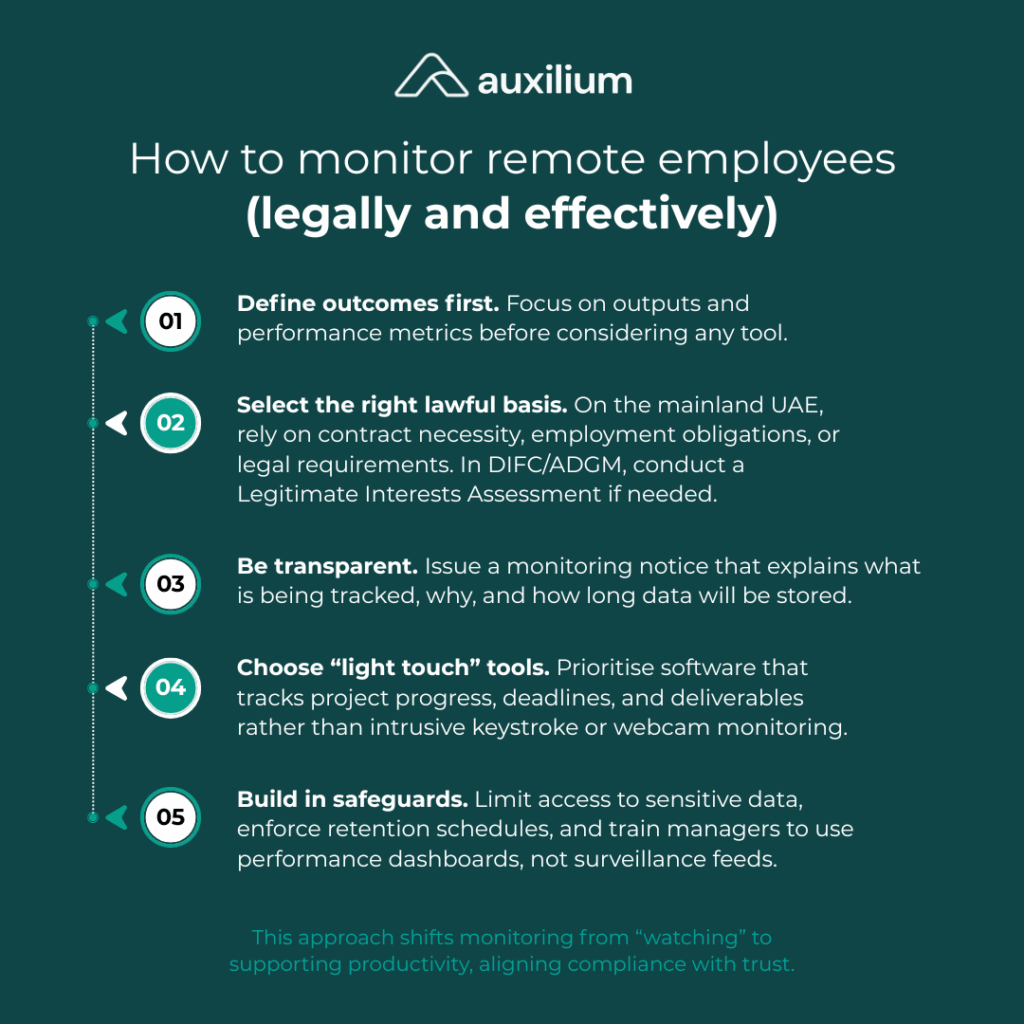
- Define outcomes first. Focus on outputs and performance metrics before considering any tool.
- Select the right lawful basis. On the mainland UAE, rely on contract necessity, employment obligations, or legal requirements. In DIFC/ADGM, conduct a Legitimate Interests Assessment if needed.
- Be transparent. Issue a monitoring notice that explains what is being tracked, why, and how long data will be stored.
- Choose “light touch” tools. Prioritise software that tracks project progress, deadlines, and deliverables rather than intrusive keystroke or webcam monitoring.
- Build in safeguards. Limit access to sensitive data, enforce retention schedules, and train managers to use performance dashboards, not surveillance feeds.
This approach shifts monitoring from “watching” to supporting productivity, aligning compliance with trust.
Do employers need consent?
Many employers assume they must get employees to “sign off” on monitoring, but in reality, consent is rarely the best path. Because the employer–employee relationship is inherently unequal, consent is rarely considered freely given. Instead, employers usually rely on other lawful bases:
- Contractual necessity: For example, tracking system access to make sure work can be carried out securely.
- Legal obligations: Such as meeting cybersecurity standards or complying with WPS/payroll requirements.
- Legitimate interests: Available in DIFC and ADGM, but requires a careful assessment to ensure monitoring doesn’t unfairly impact employees.
For consent to be valid, it must be freely given, informed, and revocable, conditions that are hard to achieve in practice. That’s why UAE employers more often rely on contractual or legal grounds when monitoring.
How to ensure ethical monitoring
Compliance alone isn’t enough. The most successful companies in the UAE pair legal safeguards with ethical practices that maintain employee trust. Ethical monitoring is about respecting boundaries while ensuring business needs are met.
To achieve that balance:
- Be upfront: Share clear monitoring notices and policies with employees.
Stay proportionate: Avoid tools like always-on webcams or GPS tracking outside work hours. - Restrict access: Limit who can view monitoring data to HR, compliance, or IT with a defined need.
- Limit retention: Keep monitoring data only as long as it remains useful.
- Manage transfers carefully: If data moves outside the UAE, use secure and compliant transfer methods.
- Respect work-life boundaries: Keep monitoring confined to company devices and work hours.
The goal isn’t surveillance, it’s accountability. Ethical monitoring strengthens performance and trust, rather than undermining it.
Methods of monitoring employee performance that work
Not all monitoring is created equal. Some methods are not only more effective but also more acceptable under UAE law. The focus should be on outputs, not surveillance.
Preferred methods include:
- Output-based performance reviews: Track KPIs, OKRs, client feedback, and quality scores.
- Workflow analytics: Use ticket systems, backlog tracking, or code review tools to assess progress.
- Client outcomes: Renewals, repeat work, and customer satisfaction tell a clearer story than screen time.
Use sparingly:
- Availability signals and status indicators.
- Timesheets for project-based or billable roles.
High risk (and best avoided):
- Always-on webcams.
- Keystroke logging.
- Secret audio or video recording.
By choosing the right methods, companies avoid legal pitfalls while encouraging accountability and results.

What’s permitted in the UAE: a quick checklist
Employers often ask: what exactly can we do under UAE law? The answer is clearer when you separate “usually permissible” practices from those that are high-risk.
Usually permissible (with proper safeguards):
- Tracking deliverables, deadlines, and contractual outputs.
- Using company devices with pre-disclosed monitoring tools.
- Reviewing system logs for justified security or quality reasons.
Likely impermissible:
- Secret audio or video recordings.
- Monitoring personal accounts or private areas of BYOD devices.
- Collecting excessive, irrelevant data such as continuous screen captures.
The principle is simple: monitor what you need, no more.
Regional nuances: when your team spans the GCC
For companies managing remote teams across multiple GCC countries, compliance becomes even more complex. Each jurisdiction has its own take on data protection and monitoring.
- Saudi Arabia: The PDPL includes legitimate interests but requires documented assessments; enforcement has tightened since September 2024.
- Qatar & Bahrain: Both have strong data protection laws with active regulators; covert monitoring is risky.
- Oman: New regulations in 2024 emphasise explicit consent and stricter compliance obligations.
- Kuwait: No single data law, rules are fragmented across sectors, making it prudent to apply UAE-level safeguards.
The safest strategy is to harmonise monitoring practices to the strictest applicable standard, ensuring consistency across all GCC operations.
Monitoring remote employees doesn’t have to mean intrusive surveillance. By aligning your practices with UAE law and focusing on outputs rather than overreach, you can protect your business, build trust, and stay competitive in attracting top talent.
Remote-employee monitoring is just one piece of the compliance puzzle. In the UAE, and across the GCC, employers must also navigate payroll rules, visa sponsorship, and end-of-service obligations.
At Auxilium, we have extensive experience helping businesses expand compliantly across the GCC. In the UAE, that means handling everything from payroll and visa sponsorship to end-of-service obligations, while guiding clients on employment practices that align with local laws.
If you’re ready to build a workforce strategy that balances performance with compliance, let’s talk.
Frequently Asked Questions
HR monitors employees by combining technology, observation, and performance tracking. Tools like time-tracking software, application usage logs, and screen-activity monitors collect quantitative data. HR also uses regular check-ins, performance appraisals, goal tracking systems, and qualitative feedback to assess productivity, conduct, and alignment with organizational objectives.
It is not inherently illegal to use employee monitoring software, but its legality depends on jurisdiction, transparency, and adherence to privacy laws. In the UAE, there is no specific law that outright bans employee monitoring, but it must have legitimate business purpose, employees should give informed consent, and policies should be clearly communicated.
To verify remote employees’ work, employers can use productivity software that tracks project milestones, timesheets, task completion rates, and application or website usage. Supplementing these metrics with regular status reports, video check-ins, and outcome-based performance evaluation helps confirm that work is being done without relying solely on continuous surveillance.



Schedule a Free Consultation
Tell us what you’re looking for and we’ll handle the rest.
Let's talk!
Please provide your details, and one of our specialists will promptly reach out to you.