
Employee Engagement in the UAE: Building a Culture that Lasts

Employee engagement in the UAE isn’t just about hosting team lunches or celebrating milestones — it’s about creating an environment where people feel secure, valued, and part of a purpose bigger than themselves. In a region shaped by cultural diversity and evolving labour laws, genuine engagement starts with understanding what matters most to employees: fair pay, predictable schedules, meaningful growth, and a sense of belonging.
This article explores how HR leaders can design a truly effective employee engagement action plan for the UAE — one that blends compliance with culture, and transforms engagement from a buzzword into a business advantage.
Why Employee Engagement Feels Different in the UAE
Every country has its own rhythm of work — and in the UAE, that rhythm beats to a unique mix of regulation, culture, and ambition. While global frameworks for engagement often focus on motivation and purpose, here in the Emirates, the building blocks are far more tangible: legal compliance, national identity, and employee wellbeing.
Recent data backs this up. According to Gallup’s State of the Global Workplace 2024, 26% of employees in the UAE describe themselves as engaged, nearly double the regional average. That’s progress worth celebrating — but also a reminder that 74% still aren’t fully connected to their work. The opportunity for improvement is enormous.
So, what makes engagement in the UAE different?
For one, trust is compliance-driven. Workers notice when salaries arrive on time under the Wage Protection System (WPS), when schedules respect the Midday Break in summer, and when hours are reduced during Ramadan. These aren’t just labour laws — they’re signals of respect.
Then there’s Emiratisation, a national priority now extending to companies with as few as 20 employees. This initiative is more than a quota; it’s a movement to integrate Emirati talent into the private sector, creating diverse teams where collaboration becomes the heart of engagement.
And finally, benefits are evolving fast. From the federal unemployment insurance (ILOE) scheme to modern savings-based end-of-service models like DIFC DEWS and the new ADGM savings framework, the UAE is redefining financial security for its workforce. When employees see these benefits communicated clearly, engagement naturally follows.
Turning Compliance into Connection
At first glance, compliance might seem like the opposite of engagement — a box-ticking exercise rather than a human experience. But in the UAE, compliance is the foundation of engagement.
When salaries are paid accurately through WPS, employees trust their employer. When outdoor work stops during the Midday Break and Ramadan hours are respected, employees feel seen. And when companies are transparent about benefits like ILOE or end-of-service savings, they foster peace of mind — one of the strongest predictors of retention.
In short, every compliant act communicates care.
HR leaders who understand this connection can transform “legal obligations” into engagement moments.
Five Pillars of Engagement that Work in the UAE
To create a culture where people choose to give their best, HR leaders need a plan grounded in five simple principles: trust, growth, voice, recognition, and wellbeing.
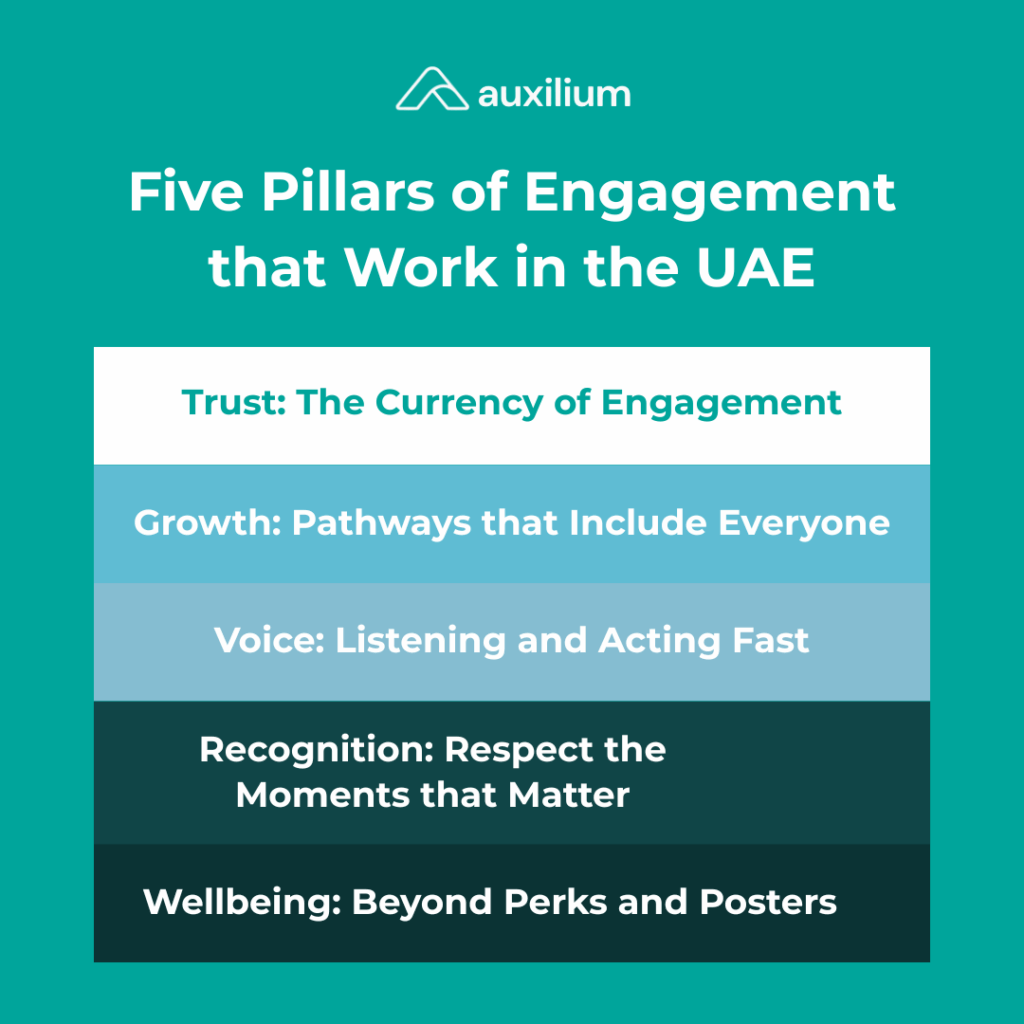
1. Trust: The Currency of Engagement
Trust begins the moment a salary lands in an employee’s account on time. In a multicultural workforce where many employees send remittances home, a delayed salary can cause real distress. Using WPS not only ensures compliance but reinforces reliability — a critical emotional anchor.
Safety also signals trust. During the Midday Break (from June 15 to September 15), respecting rest hours and ensuring hydration and shade isn’t just law — it’s leadership. Employees remember when their wellbeing is prioritised over productivity.
2. Growth: Pathways that Include Everyone
The UAE’s Emiratisation drive has added a new dimension to engagement — purpose through inclusion. When Emirati employees see genuine career paths within the private sector, and expatriates witness that national goals are being integrated fairly, the entire workplace culture becomes more cohesive.
One company I worked with created dual career ladders — one for leadership growth and one for technical mastery — tied to mentoring programs for Emirati graduates. Within six months, survey scores on “career visibility” jumped by 22%. Growth, it turned out, wasn’t about titles; it was about transparency.
3. Voice: Listening and Acting Fast
In fast-paced UAE workplaces, listening needs to be as structured as payroll. Quarterly “pulse” surveys are effective only when responses lead to visible change.
A practical rhythm looks like this: acknowledge every comment within 72 hours, implement action within 30 days, and review impact after 60. When employees see feedback turn into decisions — even small ones — trust and engagement grow exponentially.
4. Recognition: Respect the Moments that Matter
Recognition carries the most power when it’s personal and culturally aware. During Ramadan, when energy levels shift and focus turns inward, recognising quiet consistency matters as much as celebrating big wins.
Likewise, connecting recognition to local milestones — UAE National Day, Eid celebrations, or safety achievements during the Midday Break — creates shared meaning that transcends cultural boundaries.
5. Wellbeing: Beyond Perks and Posters
Engagement thrives when wellbeing feels practical, not performative. For outdoor teams, that might mean shaded rest stations, hydration stations, and shorter summer shifts. For office employees, it could be flexible start times during school term transitions or short, focused financial wellbeing sessions explaining ILOE and end-of-service benefits.
These initiatives tell employees, “We understand your life, not just your job.” And that’s what engagement is really about.
Designing Engagement Activities that Actually Work
Many HR teams feel pressure to roll out “fun” engagement activities — game days, raffles, themed lunches. While these can help, they’re not enough on their own. The best employee engagement activities in the UAE are those that combine purpose with practicality.
Start small.
- Introduce a “Trust Dashboard” that tracks salary timeliness and pay query resolution. When teams see 100% on-time pay, it builds confidence.
- During Ramadan, rework meeting norms — shorter, earlier, more focused — so people can maintain both productivity and balance.
- Celebrate compliance creatively. A “Midday Break Challenge,” where field teams are rewarded for zero safety violations, blends compliance and morale.
And don’t forget development. Pair Emirati talent with senior mentors through a career mentorship circle. It strengthens localisation goals while building belonging for everyone.
These kinds of activities turn policy into participation — and that’s when culture truly comes alive.
Building Your Employee Engagement Action Plan
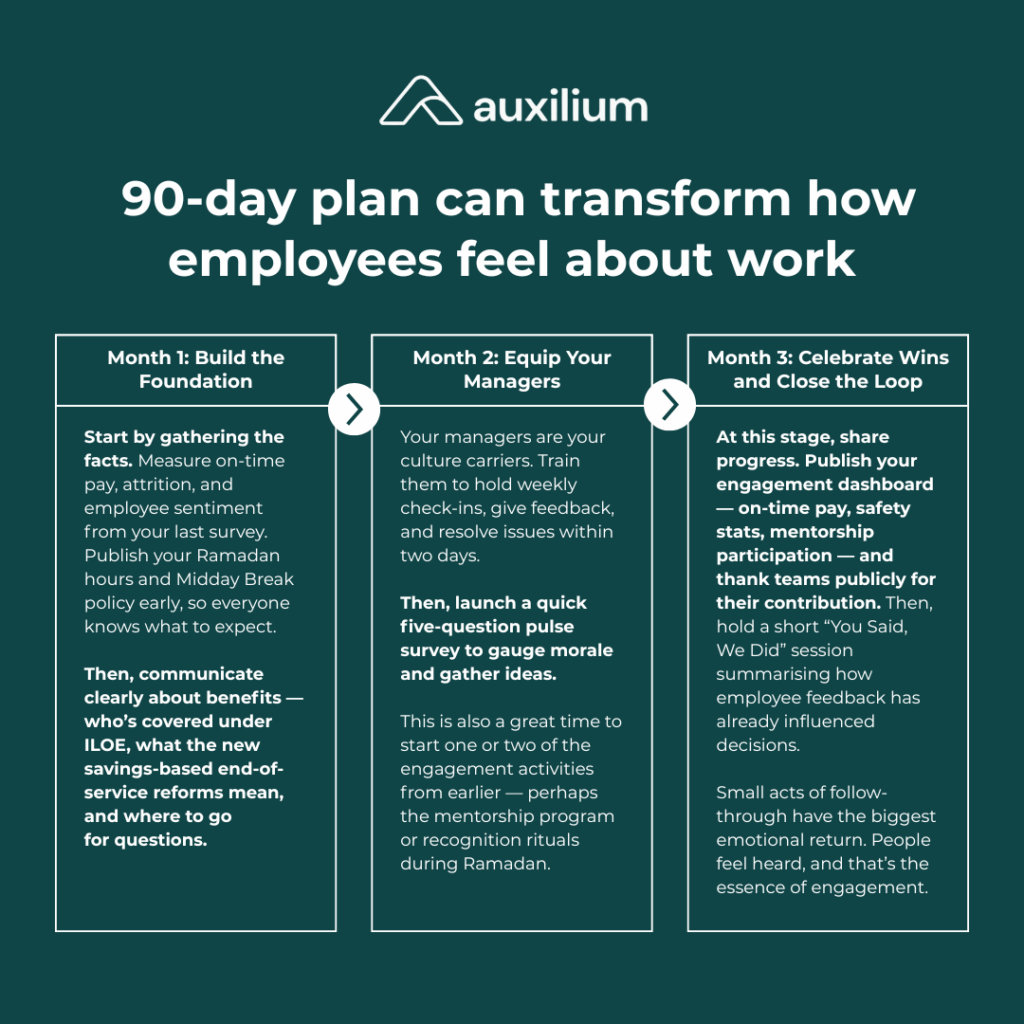
Creating an engagement plan isn’t about volume; it’s about rhythm and consistency. A practical 90-day plan can transform how employees feel about work — without overwhelming your managers.
Month 1: Build the Foundation
Start by gathering the facts. Measure on-time pay, attrition, and employee sentiment from your last survey. Publish your Ramadan hours and Midday Break policy early, so everyone knows what to expect. Then, communicate clearly about benefits — who’s covered under ILOE, what the new savings-based end-of-service reforms mean, and where to go for questions.
Transparency builds trust faster than any engagement campaign ever could.
Month 2: Equip Your Managers
Your managers are your culture carriers. Train them to hold weekly check-ins, give feedback, and resolve issues within two days. Then, launch a quick five-question pulse survey to gauge morale and gather ideas.
This is also a great time to start one or two of the engagement activities from earlier — perhaps the mentorship program or recognition rituals during Ramadan.
Month 3: Celebrate Wins and Close the Loop
At this stage, share progress. Publish your engagement dashboard — on-time pay, safety stats, mentorship participation — and thank teams publicly for their contribution. Then, hold a short “You Said, We Did” session summarising how employee feedback has already influenced decisions.
Small acts of follow-through have the biggest emotional return. People feel heard, and that’s the essence of engagement.
Avoiding Common Engagement Pitfalls
Many companies stumble by focusing on surface-level engagement — launching fun events while ignoring the basics. Employees notice when salaries are late, workloads are uneven, or feedback goes unanswered.
Don’t confuse activity with engagement. Real engagement comes from consistency, communication, and care — especially in a multicultural environment like the UAE. And remember: compliance and culture aren’t opposites. They’re partners.
Employee engagement in the UAE isn’t about reinventing the wheel; it’s about aligning business discipline with human understanding. Pay people on time. Honour cultural rhythms. Show them how they can grow, and then listen when they speak.
When companies do these things well, they don’t just retain talent; they earn loyalty.
And if managing all the moving parts of UAE employment, payroll, visas, end-of-service obligations, feels complex, that’s where a trusted Employer of Record like Auxilium comes in. We handle the compliance so you can focus on building a culture people want to stay in.
Frequently Asked Questions
Employee engagement refers to the emotional and cognitive commitment workers feel toward their organization, driving them to go above and beyond in their roles. Wellness encompasses the holistic health of employees—including physical, mental, emotional, and sometimes even financial well-being. When wellness is well supported, engagement tends to increase.
An action plan for employee engagement is a structured roadmap that begins with gathering feedback (through surveys, focus groups, or interviews), then identifying key focus areas and setting measurable goals. Next it allocates resources and responsibilities, implements initiatives (e.g. recognition programs, communication changes, wellness offerings), and periodically tracks progress, adjusts strategies, and reinvests based on results.



Schedule a Free Consultation
Tell us what you’re looking for and we’ll handle the rest.
Let's talk!
Please provide your details, and one of our specialists will promptly reach out to you.