
Remote hiring UAE: Cut time-to-first hire with an Employer of Record

If you need to hire your first employee in the UAE without opening a local entity, a compliant Employer of Record (EOR) can sponsor the visa, issue a compliant UAE employment contract, run payroll through WPS, and manage health insurance and end-of-service obligations, all under its registered entity. That means legal, fast, and low-risk remote hiring in the UAE, while you focus on growth.
Most international firms underestimate UAE onboarding. Beyond the trade license, you’ll tackle banking KYC, WPS payroll setup, health insurance, and visa quotas that can drag timelines. This guide shows why EOR is the quickest compliant route to hire in the UAE, how it works, timelines, and a real case study.
We reference UAE government guidance on work permits, WPS, health insurance, Emiratisation, and safety rules to ensure that you’ll leave with a step-by-step plan to hire in days, not months.
Why remote hiring in the UAE stalls (without EOR)
Even when your new team member will work remotely, UAE employment is location-based: if work is performed from the UAE, legal employment and sponsorship are required via a registered establishment (mainland MOHRE or a free zone). That triggers several regulatory dependencies:
- Work permit & residence visa must be issued by a UAE entity registered with MoHRE (mainland) or a free zone authority.
- Payroll via WPS. Private-sector employers must pay through the Wage Protection System to avoid fines and blocks. Many free zones also require WPS (e.g., JAFZA, DMCC).
- Health insurance is mandatory; in Dubai it’s required by Law No. 11 of 2013, and Abu Dhabi has its own mandatory scheme. Employers are responsible for coverage.
- End-of-service benefits (gratuity/savings). UAE federal law mandates gratuity; DIFC/ADGM have distinct regimes (e.g., DIFC DEWS funded plan; ADGM 2024 updates).
- Local labour programs. Emiratisation targets apply to many mainland employers (50+ staff), with stepped compliance and penalties announced by MoHRE.
Seasonal HSE rules. The Midday Break (15 June–15 Sept, 12:30–3:00 pm) affects rosters for on-site roles.
A foreign company without a UAE entity can’t legally issue visas, run WPS payroll, or sponsor benefits. That’s why entity-first hiring often takes weeks to months, including banking KYC, before your first hire can start. With an EOR, you bypass that entire setup.
What an Employer of Record (EOR) does in the UAE
An EOR is the legal employer for your UAE-based talent while you direct day-to-day work. In practice, a specialist GCC EOR (like Auxilium) provides:
- Sponsorship & visas: Applies for work permit/residence visa via its local entity; manages entry permit, medical fitness, Emirates ID, and residence stamping.
- Compliant contracts: Issues UAE-recognised fixed-term contracts aligned to Labour Law (or DIFC/ADGM where applicable).
- Payroll & WPS: Runs monthly payroll through WPS and handles salary file submissions, arrears, and compliance alerts.
- Health insurance: Places employees on compliant plans meeting emirate-specific rules (e.g., DHA Essential Benefits in Dubai).
- Leave & statutory benefits: Administers leave, end-of-service (federal gratuity) or funded schemes in financial free zones.
- Regulatory guardrails: Tracks Emiratisation applicability, HSE requirements (e.g., Midday Break), and local policy updates.
Result: You can onboard a UAE hire fast and fully compliant, without forming an entity, opening a corporate bank account, or managing visa quotas yourself.
Time-to-first-hire: entity path vs. EOR path
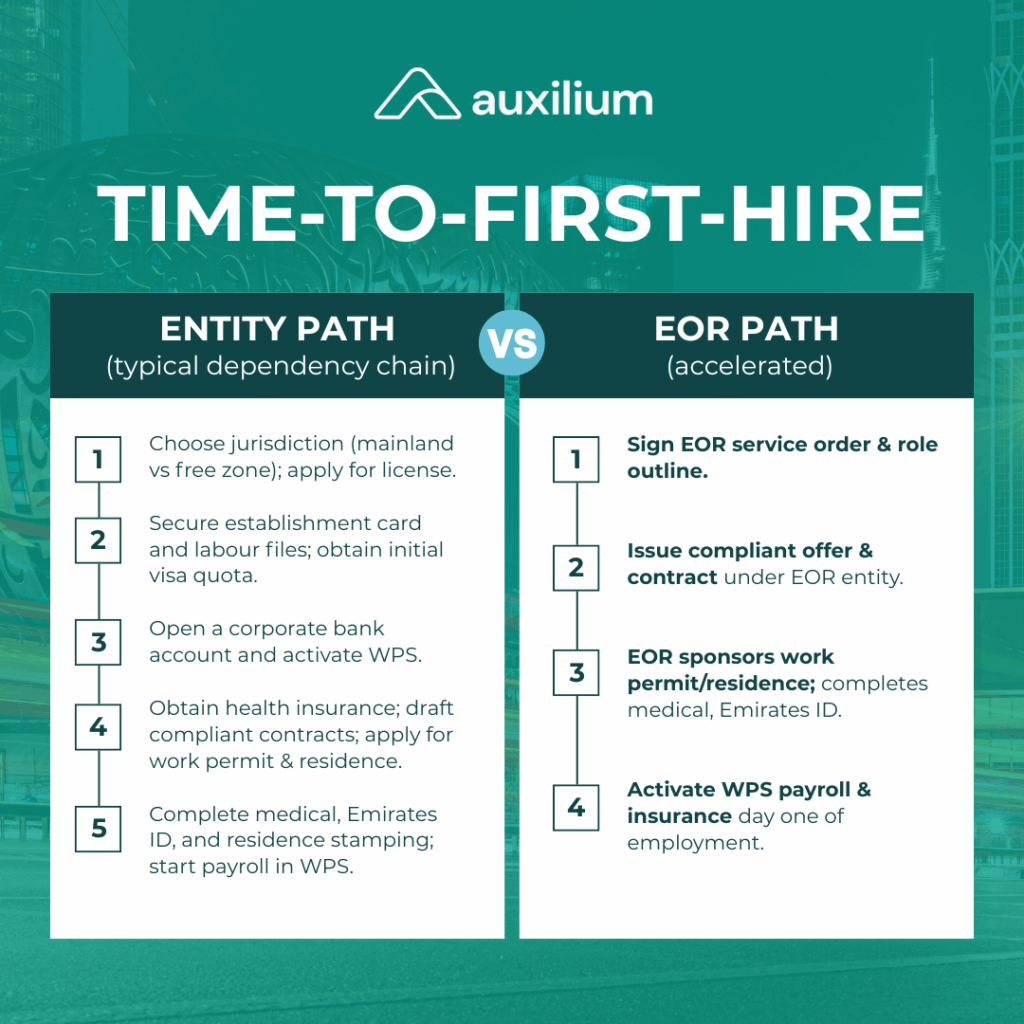
Entity path (typical dependency chain)
- Choose jurisdiction (mainland vs free zone); apply for license.
- Secure establishment card and labour files; obtain initial visa quota.
- Open a corporate bank account and activate WPS.
- Obtain health insurance; draft compliant contracts; apply for work permit & residence.
- Complete medical, Emirates ID, and residence stamping; start payroll in WPS.
Government guidance notes free zones require “minimum paperwork and duration,” and mainland applications can be submitted online quickly. But practical go-live still hinges on banking KYC, WPS onboarding, insurance issuance, and visa processing, steps an EOR already has in place.
EOR path (accelerated)
- Sign EOR service order & role outline.
- Issue compliant offer & contract under EOR entity.
- EOR sponsors work permit/residence; completes medical, Emirates ID.
- Activate WPS payroll & insurance day one of employment.
It’s important to note that only a limited number of EOR providers in the UAE are locally licensed to sponsor employment legally. Many global vendors rely on third-party intermediaries or partner entities, which can create compliance and continuity risks. When evaluating an Employer of Record, always verify that they hold a valid UAE trade license, are registered with the Ministry of Human Resources and Emiratisation (MoHRE) or the relevant free zone authority, and can issue visas and payroll through WPS under their own entity. This ensures your UAE hires are fully compliant and protected under local labour law, without exposure to misclassification or sponsorship breaches.steps an EOR already has in place.
Compliance nuances that EOR abstracts for you
Mainland vs. free zones vs. financial free zones
- Mainland (MoHRE): Federal Labour Law applies; WPS is mandatory for the private sector.
- Free zones: Many adopt WPS (e.g., JAFZA, DMCC); processes run via zone authorities.
- DIFC/ADGM: Separate employment regimes. DIFC replaced traditional gratuity with DEWS; ADGM updated its Employment Regulations in 2024/2025 with clarified end-of-service entitlements. An EOR ensures contracts/payroll align to the correct regime.
Work authorization & “remote work” visas
Dubai’s Virtual Working Programme lets people live in Dubai while working for employers outside the UAE; it does not authorize local UAE employment. If you’re hiring a UAE-based person to be your employee, they need a UAE work permit/residence sponsored by a local entity, provided via EOR if you lack an entity.
Health insurance & payroll protection
Employers must fund health insurance (e.g., DHA law in Dubai) and pay through WPS on time to avoid penalties. The EOR’s existing payroll and insurance infrastructure reduces onboarding friction and compliance risk.
Emiratisation & HSE controls
MoHRE continues phased Emiratisation targets for many mainland firms and annually enforces the Midday Break. A UAE-based EOR tracks applicability and enforces roster/policy updates in-country.
Case study: A global recruiter scaled GCC hiring with Auxilium
A global recruitment firm in digital and tech needed one partner to deploy contractors across multiple GCC markets without setting up local entities. Auxilium acted as the multi-country EOR, sponsoring visas, running payroll (incl. WPS), and managing statutory benefits. 80+ contractors were onboarded across the UAE, Qatar, and Oman, enabling faster fulfilment with zero setup delays and full local compliance.
How to use EOR for remote hiring in the UAE (step-by-step)
- Define the role & location. Confirm where the employee will live/work (emirate/jurisdiction: mainland, free zone, DIFC/ADGM).
- Right-sized contract. EOR issues a fixed-term UAE contract with compliant clauses (probation, notice, leave, non-compete).
- Visa & onboarding. EOR obtains work permit/residence, then coordinates medical, Emirates ID, and insurance card activation.
- WPS payroll. Employee is paid monthly via WPS with pay slips, arrears tracking, and salary protection monitoring.
- Benefits & EOS. Health insurance and end-of-service calculations (or DEWS in DIFC) are handled centrally.
- Ongoing compliance. EOR updates policies for Emiratisation/HSE changes and manages renewals and offboarding. MOHRE
When EOR is the best choice (and when it isn’t)
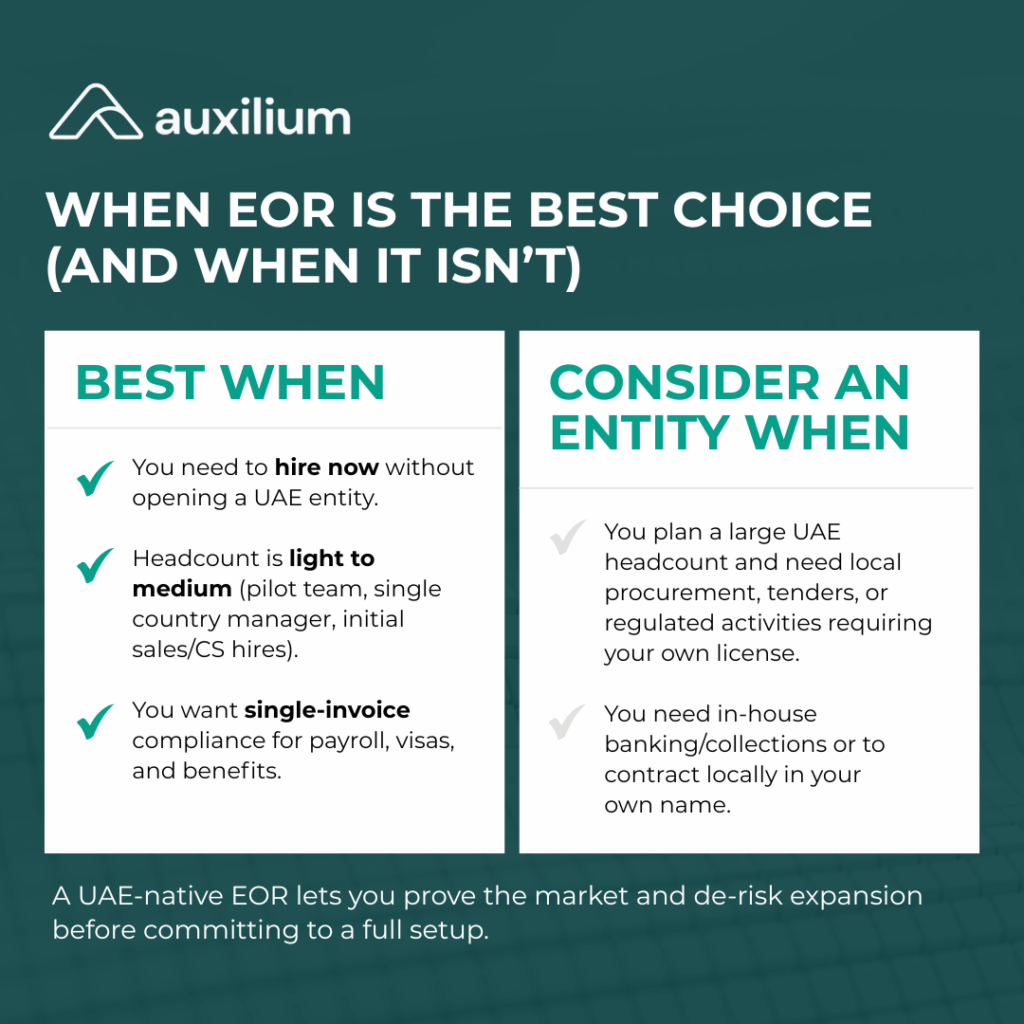
Best when:
- You need to hire now without opening a UAE entity.
- Headcount is light to medium (pilot team, single country manager, initial sales/CS hires).
- You want single-invoice compliance for payroll, visas, and benefits.
Consider an entity when:
- You plan a large UAE headcount and need local procurement, tenders, or regulated activities requiring your own license.
- You need in-house banking/collections or to contract locally in your own name.
A UAE-native EOR lets you prove the market and de-risk expansion before committing to a full setup.
Why choose Auxilium for remote hiring in the UAE
Auxilium is GCC-native, not a one-size-fits-all global vendor. With over 20 years in-market and legal presence across UAE, Saudi Arabia, Kuwait, Oman, Bahrain, and Qatar, we handle: payroll & WPS, visa processing & sponsorship, health insurance, and end-of-service, so you don’t wrestle with red tape. Hire your first UAE employee fast, then scale with confidence.
Hiring remote talent in the UAE? Auxilium’s Employer of Record service gets your team compliant and operational quickly, from visa sponsorship and WPS payroll to health insurance and end-of-service management, so you can focus on growth, not paperwork. Let’s talk about your UAE hiring plan today.
Frequently Asked Questions
A UAE remote work visa (Virtual Working Programme) costs around USD 287 (~ AED 1,050) as the official processing fee. Additional costs like health insurance, medical tests, Emirates ID, and service fees may raise the total.
It’s moderately straightforward: the remote work visa demands meeting criteria (valid passport, health insurance, proof of remote employment or business outside the UAE, and minimum income requirement). Approval typically takes a few business days.
You begin by submitting an online application via the UAE or Dubai government portal, providing a valid passport, health insurance, proof of remote work (employment contract or business registration), income statements and bank records. Once approved, you’ll complete medical screening, apply for Emirates ID, and receive the residency visa stamp.



Schedule a Free Consultation
Tell us what you’re looking for and we’ll handle the rest.
Let's talk!
Please provide your details, and one of our specialists will promptly reach out to you.